

163: Keep Creating
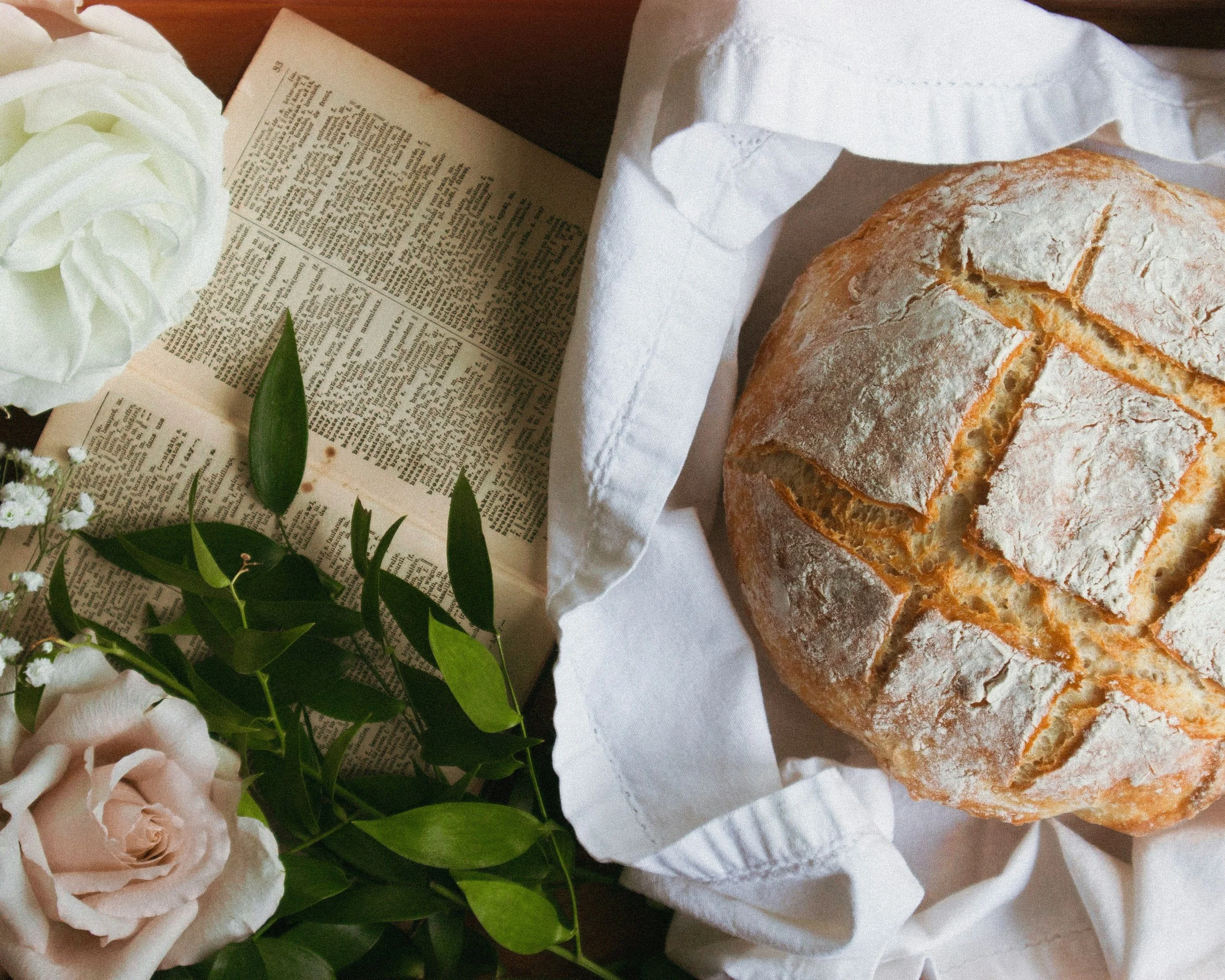
It's a Saturday morning in late October, and I'm standing in my kitchen with flour on my hands and a recipe card propped against the sugar canister. The card belonged to my grandmother. Her handwriting slants across it in blue ink, faded in some places and splattered in others {evidence, I like to think, of all the times she made this very loaf}. It's her honey wheat bread. I've eaten it more times than I can count. I've just never made it myself.
Until today.
I should mention the recipe is… let's say, loosely written. A good bit of flour. Warm water, not hot. Knead until it feels right. For someone who likes clear instructions and exact measurements, this is not ideal. But I roll up my sleeves and begin anyway.
I stir the yeast into the warm-not-hot water and wait for it to foam. I add the honey, the salt, and the flour, a good bit of it. Then I knead. And knead. And knead some more. My arms start to ache, and I'm honestly not sure what "feels right" is supposed to feel like. Eventually, though, the dough turns smooth and a little springy under my palms. I place it in a greased bowl, cover it with a dish towel, and set it on the counter to rise.
And then comes the hardest part: waiting.
I am not a patient person. Not really. So every fifteen minutes or so, I wander back into the kitchen and lift the corner of the towel. Just a peek. Nothing. I peek again. Still nothing. Or at least, nothing I can see. I start to worry I killed the yeast. I start to wonder if I should just start over.
Finally, I make myself leave the kitchen altogether. I fold laundry. I call my sister. I sit on the back porch with a cup of coffee. And when I come back an hour later and lift the towel, there it is. The dough has doubled, soft and full, pressing up against the edges of the bowl.
A few hours later, the house smells exactly like my grandmother's kitchen. I pull the loaf from the oven, golden brown and a little lopsided, and I cut into it far too soon {because, again, patience}. It's not perfect. But it's warm, it's good, and I made it.
*******
It’s a story that showcases just how long and difficult the creative process can be—whether we’re baking or building or writing or painting or preaching or planning or designing or even calculating, creating anything is rarely a piece of cake {or honey wheat bread}. And yet, the story I just shared with you about making that bread, was actually super easy to create. Because I didn’t write it. Claude did.
Claude, as in one current form of Artificial Intelligence—an LLM or Large Language Model designed to understand, summarize, translate and generate human text.
The bread-making story is not an actual memory of mine. I didn’t make any bread that day. In fact, I don’t think I’ve ever made a loaf of bread from scratch that way. The whole experience was not real. All of it was generated by AI.
To create it, I simply gave Claude the following prompt:
Read the transcripts from all of the Remind{h}er podcasts by Julianne Clayton. After reading them, write an original opening story about creating or making something in Julianne’s voice and writing style between 300 and 500 words.
About 30 seconds later, voila! The intro to this episode was written. Just to put that in perspective, it usually takes me at least 3-4 days to brainstorm and write an intro story like that. Claude did it in a fraction of a fraction of that time. And, I might add, made it seem so very easy.
And really, that the key. Because easy is often what we’re after. We search for “easy everywhere” as author Andy Crouch likes to say. At nearly every turn, we are prone to pick the path of least resistance. Because it seems if we can escape the strain, dodge the wait, remove the struggle, then our work will feel effortless and our lives will soon become endlessly enjoyable. Or so we assume.
One thing I’m learning, though, is that it is often through tension and discomfort that I am most deeply shaped and formed for the better.
Here’s what I mean: a couple weeks ago, I knew I wanted to do an episode exploring AI and its effect on the creative process. And as I was brainstorming, I decided to test out AI just to see what it could do. As I just revealed to you, I discovered it is possible to way-more-easily create these podcast episodes than I ever even imagined. All I need to do is send a prompt and let AI take care of the rest. If I did that and never announced it, I’m not sure anyone listening would really even know the difference.
But I would. And I’m discovering just how much that matters.
Over the past six and a half years, creating each episode of this podcast has become more than just a hobby; it’s become a spiritual practice. It takes time. And effort. And discipline. And a willingness to wrestle. To struggle. To sit in the tension and frustration that often show up during the creative process. Never in a million years would I describe this work as easy. And yet, I do consider it a grace. This work has deepened my awareness of God’s presence and movement in my life; it has helped me hone my craft; it has helped me find my voice. It is one of the ways God enables me to steward my gifting. I believe it is a project I participate in and co-create with God. And in doing so, I sense within me a deepened trust, a loosened grip, a more nourished soul.
And here’s the thing: I’m just not convinced the deep inner work we experience during the creative process can be outsourced.
I also don’t think it’s meant to be.
As human beings, we were created in the image of God, and our God is a Maker, an Author, a Creator. In Genesis 1, God speaks creation into being. But when we dig a little deeper and look to Genesis 2, we also see God’s creative process in action. In Genesis 2:7-8, we read:
“…then the Lord God formed man from the dust of the ground and breathed into his nostrils the breath of life, and the man became a living being. And the Lord God planted a garden in Eden, in the east, and there he put the man whom he had formed.”
God took time to gather up dirt, carefully shaped into human form, and filled it with God’s very breath. God used a part of God’s very self to create us. Then God took the time to plant a garden—which is no small task—and placed the human in the garden and then invited that human to join in and be a part of the continued creative process.
This echoes what we read in verses like Psalm 139:13—God forms us by knitting us together in our mother’s womb. It’s a process that takes time, and focus, and intention, and care.
And so I wonder if, in order for us to fully exercise the image of God within us, we need to engage that kind of creative process, too. Whether we’re baking or building or writing or painting or preaching or planning or calculating or designing, we are meant to co-create with God. And as we do, the stewardship of our gifting and passion becomes a spiritual practice that continues to form us for the better.
Now, it feels important to say that the current conversation surrounding AI is quite large; there is much to consider and many layers to explore and I can’t possibly address it all in just one episode. I’m also not suggesting a total rejection of all things AI; I do believe, as people of faith, it can be a tool we choose to use in wise, discerning, care-full ways. And…
When we use AI in ways that stifle the image of God within us, when we choose to rely on AI rather than the Spirit of God and one another, when we outsource our calling to AI for the sake of efficiency and convenience, I can’t help but wonder if we’re forfeiting the sacred work that contributes to the continued formation of our human souls.
In her book, The Right to Write, Julia Cameron put it this way {and FYI, for the purposes of this episode, I’ve switched out the words ‘write’ and ‘writing’ with ‘create’ and ‘creating’}:
“We should {create} because it is human nature to {create}. {Creating} claims our world. It makes it directly and specifically our own. We should {create} because humans are spiritual beings and {creating} is a powerful form of prayer and meditation, connecting us both to our own insights and to a higher and deeper level of inner guidance.
We should {create} because {creating} brings clarity and passion to the act of living. {Creating} is sensual, experiential, grounding. We should {create} because {creating} is good for the soul. We should {create} because {creating} yields us a body of work, a felt path through the world we live in.
We should {create}, above all, because we are {made in the image of a Creator}…”
So today, whatever your calling or gifting may be, remember to keep creating. Remember that “real” often takes a very long time. And maybe, that’s okay. Maybe it’s even something God would call very good. And as we continue to co-create with God, may we also, together, continue to become the people God calls and invites us to be.