

160: Ask For Help
I sat in Mrs. Allen’s 7th grade math class. We were about to begin a new pre-algebra unit and I was not excited about it. It was true back then and it’s still true today—numbers are not my thing.
Mrs. Allen stood in front of our class that day and walked us through several different equations. And toward the end of her instruction, she asked,
Are there any questions?
I thought to myself, “Yes, actually, I have so many questions the first of which is, can you please start over? Because this makes absolutely no sense.”
Despite holding that quiet truth within, I didn’t dare raise my hand. I was one of the “good” students and had a reputation to protect. A couple classmates did raise their hands and asked away. Unfortunately, even after listening in on their brief q+a, I remained totally confused.
We were then directed to open our workbooks and complete a set of equations on our own. As always, if we needed any help, we could come see Mrs. Allen at her desk. Which, of course, I’d never be caught doing. I’d figure this out on my own; I always did.
For the remainder of class, despite my best efforts, I massively struggled through. These were math problems I couldn’t solve. When the time came to check our work, none of my answers matched the correct ones. And so when Mrs. Allen handed out an entire packet of equations for homework, my soul pretty much shriveled up. I had a long evening ahead of me
The next day, I handed in my completed packet; I’d done the best I could. The day after that, Mrs. Allen asked me to stay after class.
She shared with me it was clear to her I was struggling. I suppose my attempted answers in the homework packet were proof enough. This fake-it-til-you-make-it thing wasn’t doing me any good.
“It’s okay if you don’t get it right away,” Mrs. Allen said. “But if something doesn’t make sense, I want you to ask for help.”
For the next couple days during my lunch period, I swallowed my pride and joined Mrs. Allen for extra instruction and support. Eventually, the math lesson clicked. But that larger life lesson? Not so much.
It’s a super low-stakes example from my adolescent years, but it highlights a reality I know quite well to this day: when it comes to asking for help, I’d much rather not. I’m ready to offer, reluctant to ask.
From a very young age, we are encouraged to move toward self-sufficiency. From learning to feed ourselves, use the bathroom ourselves, get dressed and tie our shoes ourselves, all the way to the day when we can finally drive ourselves and eventually support ourselves—a sort of healthy independence is where we’re headed.
That is all well and good. But in my own life, I find I can take self-sufficiency a little too far and rely only on myself a little too much. This can look lots of different ways and comes from several different places. For example:
My pride says I should be able to handle this, carry this, solve this on my own.
Shame says I don’t want to be a burden or a downer.
Distrust says I’m the only one who can get it right.
Control says I’m in charge.
The more I start to internalize and believe those messages, the easier it is to take on more than is wise or even possible. I fully lean into the facade that all is well and quickly come face to face with exhaustion, discouragement, and overwhelm. I become so hyper-focused on the problems and my ability to solve them. I forget I’m not meant to do everything all on my own. Maybe you can relate?
It’s interesting to note that just as we move toward independence at a young age, as we near the end of our lives, we typically move back toward dependence again. Which makes me wonder if self-reliance might just be an illusion.
The reality is, whether we’re willing to acknowledge it or not, we are limited beings who will eventually face our limits head on. We will reach the end of our metaphorical ropes. We will find ourselves in need. And I’m learning, in those moments, we can keep pushing, keep proving, keep trying to hold it all on our own; or we can welcome our need and remember it’s okay to ask for help.
Of course, this invitation is nothing new. We are reminded of this human reality all throughout Scripture. And perhaps one of the most well-known reminders is Psalm 121. In it, we read:
I lift up my eyes to the hills—
from where will my help come?
2
My help comes from the Lord,
who made heaven and earth.
3
He will not let your foot be moved;
he who keeps you will not slumber.
4
He who keeps Israel
will neither slumber nor sleep.
5
The Lord is your keeper;
the Lord is your shade at your right hand.
6
The sun shall not strike you by day
nor the moon by night.
7
The Lord will keep you from all evil;
he will keep your life.
8
The Lord will keep
your going out and your coming in
from this time on and forevermore.
It’s a beautiful reminder of the ways God cares for us, watches over us, helps us all along the way. But I wonder if the key here, is that the psalmist begins from a place of honest need.
I lift up my eyes…
I’m desperate for help…
I can’t keep going without knowing I’m not in this alone.
In a recent sermon on Psalm 121, Rev. Dr. Khalia Williams offered that help came to the psalmist as the psalmist acknowledged their need. This is a Psalm of Ascent, meaning it was likely written during a strenuous journey. And along the way, the psalmist reached a point of complete overwhelm. Rather than remain hyper-focused on the hard road ahead and the weight of all they carried, they lifted their eyes and remembered they didn’t have to carry on on their own.
I wonder if, in some sense, lifting their eyes was asking for help. As author Anne Lamott offers in her book, Help, Thanks, Wow:
Praying ‘Help’ means that we ask that Something give us the courage to stop in our tracks, right where we are, and turn our fixation away from the Gordian knot of our problems. We stop the toxic peering and instead turn our eyes to something else: to our feet on the sidewalk, to the middle distance, to the hills, whence our help comes… Maybe this is a shift of only eight degrees, but it can be a miracle. It may be one of those miracles where your heart sinks, because you think it means you have lost. But in surrender you have won.
Help. Help us walk through this. Help us come through. This is the first great prayer.
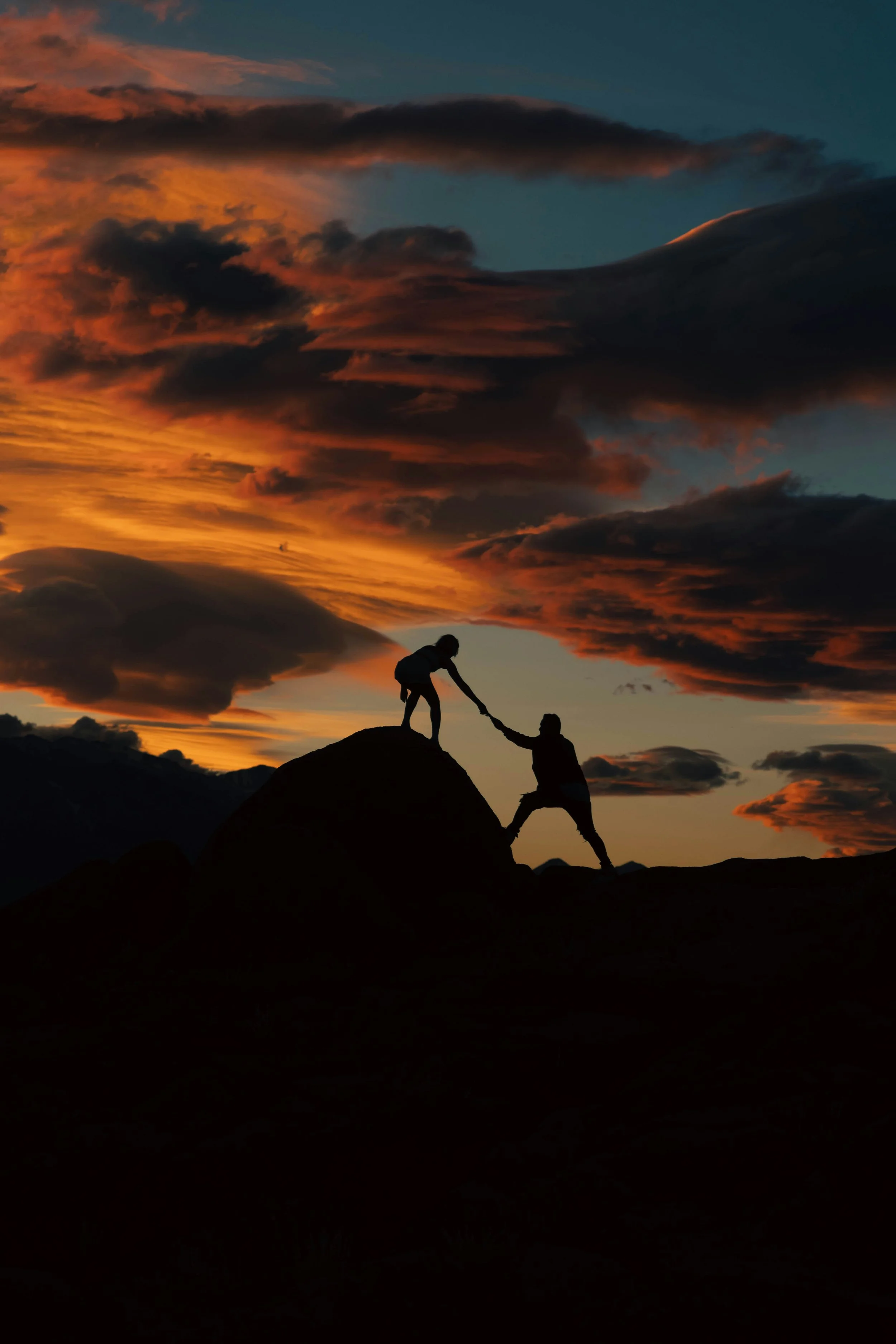
It takes great wisdom, strength, courage and humility to acknowledge our need and ask for help, both before God and one another. And I’m discovering the ways in which it is an important spiritual practice. It’s a practice that invites us to set aside our pride, shame, distrust, or ultimate need for control. It’s a practice that reveals the ways in which we need each other by design. It’s a practice that helps us remember life is less like a solo assignment and more like an intricate group project.
So what might it look like to ask for help? Of course, as the writer of Psalm 121 reminds us, our help comes from God. So we practice naming and sharing what we need, and more often than not, God provides in very practical ways.
It might begin as an honest personal prayer and then become a prayer request in trusted circles.
It might look like financial assistance or meeting basic needs.
It might look like a therapist, a coach, or a spiritual director to support healing and growth.
It might look like a wise word, a second set of eyes, a guiding hand or a listening ear.
It might look like delegation.
It might look like a ride, a meal, a treatment, a service, a fresh start.
This list goes on.
I’m learning God meets us in our need most often through each other. We are not meant to carry it all, all on our own. Instead, we lean in, take turns, offer and receive as each of us has need. We learn to share the load and as we do, we remind each other we’re not in this alone.
So today, remember to lift your eyes, acknowledge your need, and ask for help. In wisdom, strength, courage, and humility, together, may we continue to become the people God calls and invites us to be.